
Gwinnett Sentenced-Offender Releases
Gwinnett County Correctional Institution sits within the county Department of Corrections’ Comprehensive Correctional Complex. Its population serves sentences rather than awaiting the usual bond or first court hearing. That makes a release from the institution a sentence-administration event. It may reflect completion of a county sentence, a state-offender discharge, parole, probation, a court order, or transfer to another authority.
The first question is who owns the sentence. County Corrections and the sentencing court are the main sources for a county-sentenced offender. The Georgia Department of Corrections, or GDC, becomes central when the person is a state offender housed at the county institution. If supervision follows confinement, the Georgia State Board of Pardons and Paroles and the Department of Community Supervision, known as DCS, can provide the next status layer.
Where Gwinnett Releases Lead
Leaving Gwinnett County Correctional Institution does not always mean unrestricted return to the community. A person may complete a sentence and leave without another custodial placement. Another may move to parole or probation, which permits community living under stated conditions. A transfer can instead place the person in GDC custody, another county facility, or the custody of an agency that lodged a hold.
| Release path | Record to check |
|---|---|
| County sentence completed | Gwinnett County Corrections and sentencing court |
| State sentence released or discharged | GDC inactive-offender record and Inmate Records verification |
| Parole | Parole Board record, GDC status, and DCS office |
| Probation after confinement | Court order and DCS supervision record |
| Transfer or detainer | Corrections record and receiving authority |
A discharge means the relevant correctional sentence or supervision term has ended. Parole is release from prison before the sentence’s maximum end under Board conditions. Probation is court-ordered community supervision. Those outcomes are not interchangeable, so the final record should name the actual path.
Confirm a Gwinnett Institution Release
Collect the full legal name, date of birth, sentencing case number, possible GDC ID, and an estimated release period. A GDC ID is the unique state corrections number, also called a UNO. These identifiers reduce false matches and help connect a public search result with a court or agency record.
- Ask Gwinnett County Corrections whether the person was county-sentenced or held as a state offender.
- For county-sentenced time, request the completion, release, or transfer status and check the sentencing court’s final orders.
- For a state offender, search GDC by name, GDC ID or UNO, or case number, and include inactive records.
- Read the GDC sentence status and most recent institution, then seek written verification when the result is important.
- Check the Parole Board and DCS when the record shows parole or felony probation.
- Contact the receiving agency if Corrections reports a transfer, hold, or detainer.
The Gwinnett County released-inmate search and records path explains how county, state, court, and federal sources fit together. For this institution, however, the process starts with county Corrections and sentence status, not with a recent arrest booking.
GDC Gwinnett Release Search
The GDC Offender Query covers active and inactive state offenders. Use inactive scope when checking a person who is no longer incarcerated. The form accepts a name, GDC ID, case number, conviction county, most recent institution, and other descriptive fields. Its sentence-status options include “Released In The Past 15 Days,” which is a state-prison filter rather than a Gwinnett County jail release list.
A public GDC result can establish a strong lead, but GDC warns that its information may not be complete. The agency directs written verification to Inmate Records and Information, PO Box 1529, Forsyth, GA 31029. A county-sentenced person may not have the same state record trail, so a failed GDC search does not prove that the person remained at the institution.
The official GDC institution page is captured below.
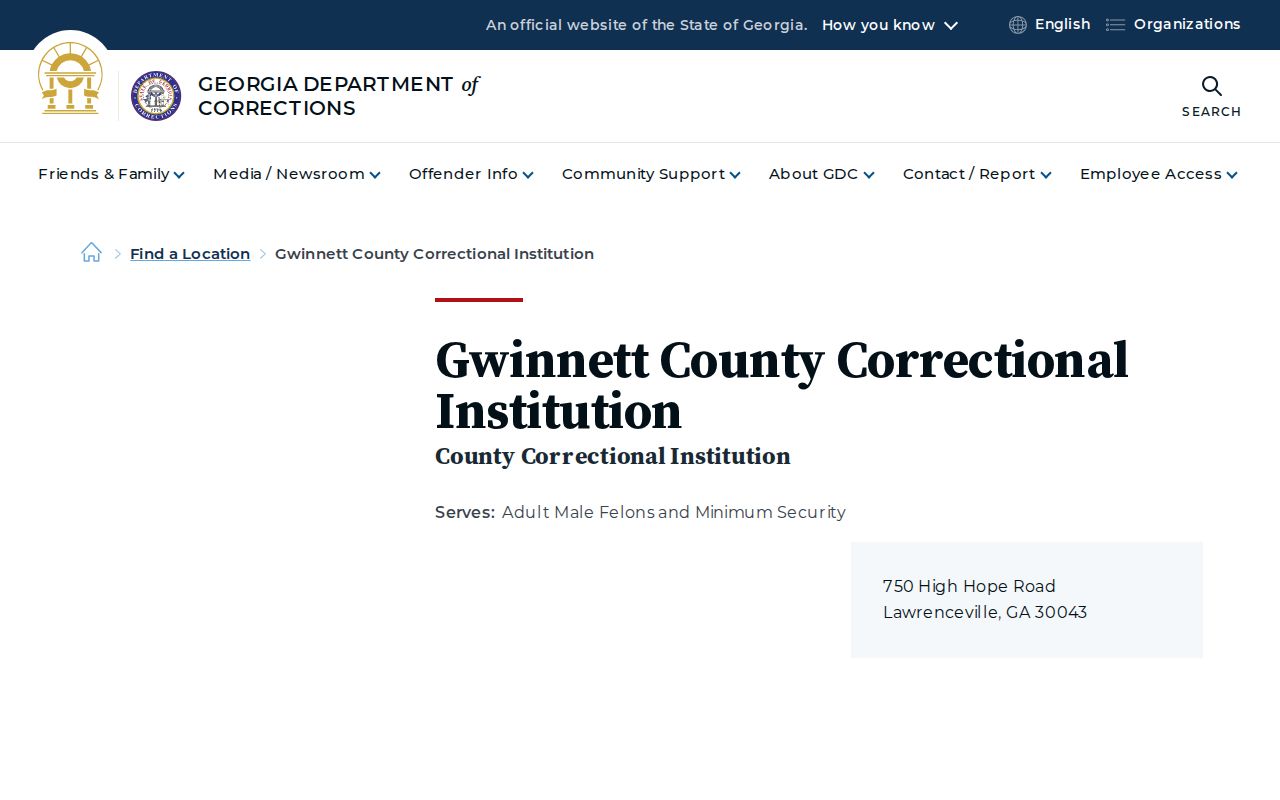
The GDC listing confirms the institution’s county-facility status, security level, capacity, sentenced population mix, and work details that distinguish it from the Sheriff’s jail.
Gwinnett Correctional Records Contact
Gwinnett County Department of Corrections operates the complex at 750 Hi-Hope Road, Lawrenceville, Georgia 30043. The main number is 678-407-6000. Inmate Counselors can be reached at 678-407-6032, while Inmate Programs uses 678-407-6065. Ask which unit holds the releasable sentence-completion, discharge, or transfer record.
Gwinnett County Department of Corrections
Comprehensive Correctional Complex
750 Hi-Hope Road
Lawrenceville, GA 30043
Main: 678-407-6000
Inmate Counselors: 678-407-6032
Inmate Programs: 678-407-6065
A focused request should include the person’s full name, date of birth, case number, sentence date, and the record sought. Examples include the release date, sentence-completion record, transfer destination, or agency responsible for supervision. County Corrections can address the physical endpoint. The court remains the source for the order that set or changed the sentence.
Gwinnett Correctional Complex History
Gwinnett’s facility structure is unusual because the county Department of Corrections runs a sentenced-offender complex in addition to the Sheriff-operated jail. The Comprehensive Correctional Complex opened in September 2002. Gwinnett County describes 800 beds across the complex, divided between 512 full-time incarceration beds and 288 Work Release Program beds.
GDC describes the Correctional Institution itself as a minimum-security county facility with a capacity of 512. Its eight dormitories hold 128 state offenders and 384 county-sentenced offenders. The location also provides 31 offender work crews. Those figures explain why one lookup cannot cover every person leaving the site.
The wider complex also includes Work Release, but leaving for approved work is not release from custody. The resident’s specific unit and sentence type must be confirmed before selecting a record system.
Gwinnett Court Release Records
The sentencing court supplies the legal basis for confinement and release. Its docket may show the original sentence, later modification, probation terms, revocation, remand, or an order that sends the person to another facility. Remand means return to custody by court order. A case number is the safest way to link the court file to a Corrections or GDC result.
Gwinnett’s case-search hub separates Superior, State, Magistrate, Probate Estate, and Recorder’s Court access. Select the court that issued the sentence instead of assuming one portal covers all cases. If the public entry is unclear or a certified order is required, contact that court’s clerk. A court order explains the authority, while Corrections confirms when and how the institution carried it out.
Read court and custody records together. A sentence may end at the institution while probation begins in the community. Conversely, an institution exit can result from transfer, not sentence completion. The later order or receiving-agency record resolves that difference.
Gwinnett Release Supervision Records
Some state offenders leave on parole, and some county sentences include probation after confinement. The Parole Board controls parole decisions for eligible state offenders. DCS handles field supervision. Its Lawrenceville office serves Gwinnett County and the Gwinnett Judicial Circuit at 410 West Oak Street, Lawrenceville, GA 30046, with phone 770-339-2222.
A Tentative Parole Month is not proof that release occurred. It marks a possible parole time frame and may change. Confirm the final custody status through GDC and the Board, then use DCS for current supervision information. For probation, start with the signed court order and verify the supervising office.
- Parole
- Conditional community release before a state prison sentence reaches its maximum end.
- Probation
- Court-ordered community supervision that may follow confinement.
- Discharge
- The end of the identified sentence or supervision obligation.
- Transfer
- Movement from one custody authority or facility to another.
Gwinnett Release Holds and Detainers
A detainer is another authority’s request to take or continue custody. If one applies, Gwinnett County Correctional Institution may release the person from its own count while transferring that person directly elsewhere. That is an institutional release, but it is not release to the community.
Ask county Corrections to identify the receiving authority when the public record permits. Check GDC for a state transfer and the receiving county for another local placement. If immigration custody is a concern, ICE’s Online Detainee Locator System is the official current-detention tool and searches by A-number and country of birth or by biographical details. A missing ICE result is not a county release certificate.
Holds must be read cautiously. Their presence can explain why an expected release did not result in a community return. The receiving agency owns the next status once the transfer is complete.
Other Gwinnett Release Facilities
Three Gwinnett facilities serve different custody purposes. The Sheriff’s Gwinnett County Jail handles bookings, pretrial custody, bond releases, and other jail events. Gwinnett County Correctional Institution holds sentenced county and state offenders. The Work Release Program is a structured sentencing alternative in the same wider complex.
SmartWEB leads for a Sheriff’s jail release. County Corrections and court records lead for the institution’s county-sentenced population, with GDC, the Parole Board, and DCS added for state offenders or supervision. Work Release completion requires its own program, court, and Corrections trail. Identifying the correct facility prevents a false conclusion based on the wrong roster.
Public Record Search
Sponsored Results